There was a period when my morning routine felt unnecessarily slow, but not in a way I could easily explain. My products were consistent. My steps were consistent. My energy level didn’t fluctuate enough to account for the delays. The interruptions were small, but they accumulated.
Some mornings I moved through the routine smoothly; other mornings felt scattered despite following the same process. It took me much longer than I care to admit to realize the slowdown was the way my hands were being forced to navigate around objects.
Once I began paying attention, I noticed my hands always moved in a predictable rhythm. They reached left before they reached forward. They reached forward before they reached right. They reached for certain textures before others, certain shapes before others, certain bottle weights before others.
The conclusion became obvious once I finally acknowledged the pattern: my hands already had an internal order, but my products did not follow that order. They were arranged visually, not functionally, and the mismatch created friction I had been treating as part of the routine.
The Morning That Made the Problem Impossible to Ignore
One morning when I was running later than usual, I placed the essential products in a straight line purely out of urgency, arranging them in the exact sequence I expected to use them. It wasn’t meant to be a solution; it was simply a way to avoid unnecessary searching.
But as soon as I began moving through the routine, the difference was unmistakable. There was no hesitation. There was no scanning the surface to locate what came next. There was no interruption caused by reaching around objects that weren’t supposed to be in that position.
My hands reached for each product naturally, as if the layout had finally aligned with what they had been trying to do all along.
That moment revealed something that should have been obvious much earlier: if the order of the products matched the order of my movements, the routine wouldn’t just be faster, it would also be steadier and completely free of micro-disruptions.

Designing a Divider Based on Movement Instead of Aesthetics
Most storage systems are built around categories, visual appeal, or space efficiency. None of those concepts helped me because my problem wasn’t aesthetic and it wasn’t about maximizing space.
It was about movement. I needed something that could keep products in a fixed, linear sequence, where each item had a defined position that didn’t shift throughout the week.
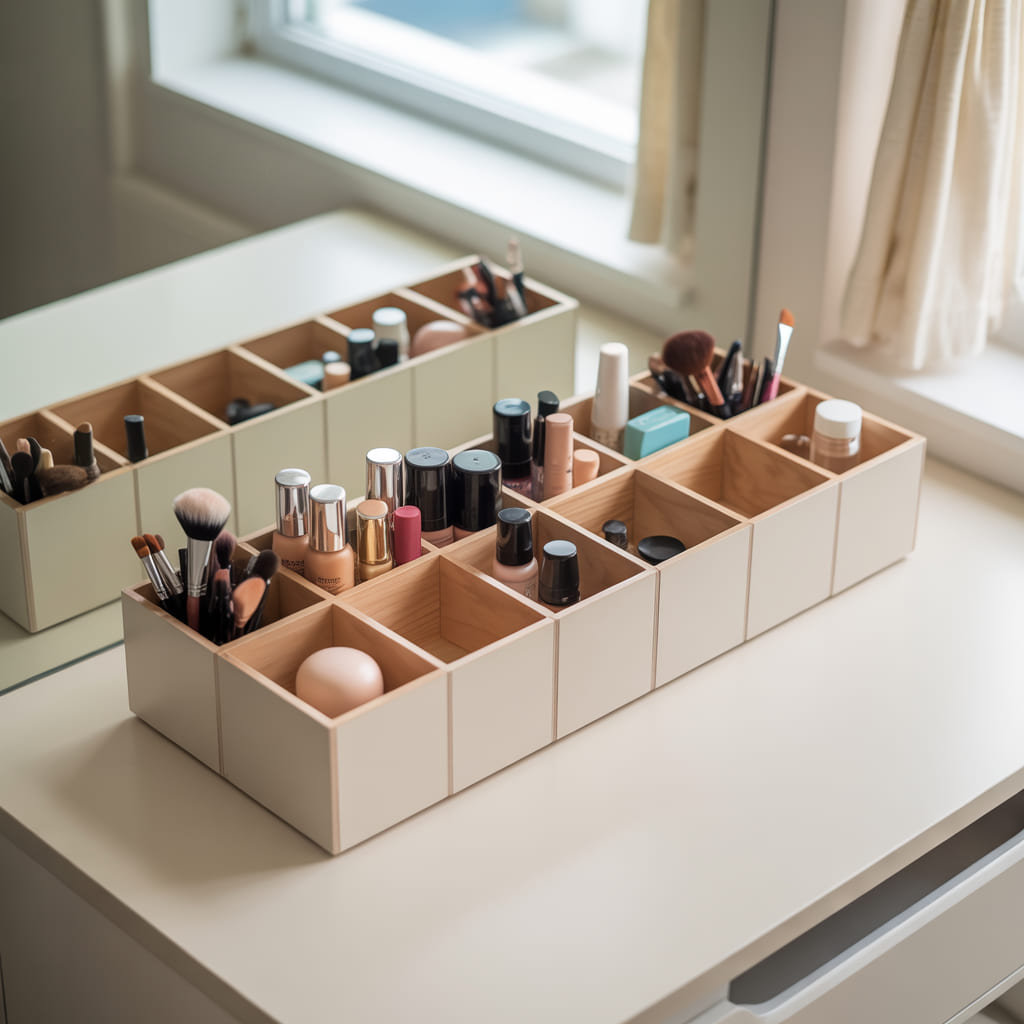
The divider I built is extremely simple, but its simplicity is what makes it effective. It is a long, narrow structure with several evenly spaced partitions, placed directly on the surface where my routine begins every morning.
The divider’s only purpose is to hold each product in the precise location where my hand naturally reaches for it. By stabilizing these positions, the divider removes every subtle delay created by drifting bottles, rolling tubes, or misplaced compacts.
Instead of grouping products by brand or type or height, I assigned each position according to the exact sequence of movements my routine follows. Cleanser, prep, hydration, base, definition, finishing.
The First Week of Using the Divider Showed Me Exactly How Much Time I Had Been Losing
The difference wasn’t dramatic in the sense of speed alone. What changed most noticeably was the continuity of the routine. There was no break in concentration, no small detours, and no hesitation between steps.
The flow became uninterrupted. The movement turned into something that felt almost automatic, not because I disengaged, but because the environment finally aligned with how I already operated.
What surprised me most was how much of the mental load disappeared once the products no longer shifted around the surface. I didn’t have to think about where something was or whether it had drifted behind another item. I didn’t have to scan the surface to locate my next step.
The divider eliminated these tasks without drawing attention to itself, and the absence of these tiny uninterrupted decisions made the routine more predictable than it had ever been.
How This Adjustment Held Up Even on Chaotic Mornings
The real test came on mornings when I was distracted or rushed, because that is when routines tend to fall apart. But even in those conditions, the divider held the sequence in place.
It prevented products from drifting out of order. It prevented me from accidentally skipping a step. It prevented the small lapses that usually lead to larger ones. The routine remained intact even when my focus didn’t.
This made me realize that organization is most effective when it removes the need for attention rather than demanding it. A good system doesn’t require the user to maintain it mentally; it maintains itself by design.
The divider does exactly that. It stabilizes the environment so the routine can operate reliably without requiring constant correction.
Why I Built the Divider Myself Instead of Buying One
I looked at several store-bought organizers before building my own, and none of them solved the problem because they were designed around categories rather than sequences.
They grouped products by type, not by movement. They optimized storage rather than flow. Most had compartments that were too deep, too narrow, or too visually oriented to match the logic of my routine.
The solution needed to follow my hand’s path, not a salesperson’s design. A DIY divider allowed me to choose the exact width of each section, the exact spacing, and the exact length required to align with my surface.
More importantly, it allowed me to design around the behavior I already had, not force a new behavior onto the routine. This approach created a system that didn’t ask me to change. It simply supported what I was already doing.
The Divider’s Real Impact
The divider didn’t transform my routine in a dramatic or decorative way. What it did was eliminate the friction that I had been mistaking for part of the process. It removed hesitation. It removed searching. It removed interruptions I had accepted as normal.
By holding every product in the exact position where my hand expects it to be, the divider created a morning routine that feels uninterrupted from start to finish.
This experience reinforced something I have learned repeatedly through other adjustments: many routine problems have nothing to do with the routine itself.
They come from environmental misalignment, small mismatches between movement and placement that create ongoing inefficiency. Once the environment changes, the routine stabilizes.
The divider is simple, but its impact lies in how precisely it supports the natural sequence of my actions. When the space cooperates with the body, everything becomes more predictable, more coherent, and more consistent.
A Closing Reflection from Juno Wilde
I built the divider because I finally understood that my routine was simply operating in a space that worked against my movements instead of with them. The divider functions as a structural correction, a physical adjustment that removes friction without adding complexity.
It taught me that good systems don’t change the routine. They reinforce it. And sometimes the most effective improvements come not from new products or new techniques, but from noticing how the body moves when nothing interferes with it.